Could a longevity breakthrough cause a pensions crisis?

Suppose a longevity breakthrough adds ten years to the life expectancy of a 65-year-old. What happens to pensions?
A new scenario analysis argues that a rapid, large increase in life expectancy is a credible and underappreciated systemic risk – and that the financial shock would arrive years, or even decades, before the extra years of life do.
Guy Coughlan (an independent pensions and risk management advisor) and Richard Faragher (Professor of Biogerontology at the University of Brighton) have sketched out one answer in their new report, Extreme Longevity: A science-based scenario analysis, and it makes for sobering reading if you’re in a business whose bottom line depends on assumptions about future mortality.
The bad news
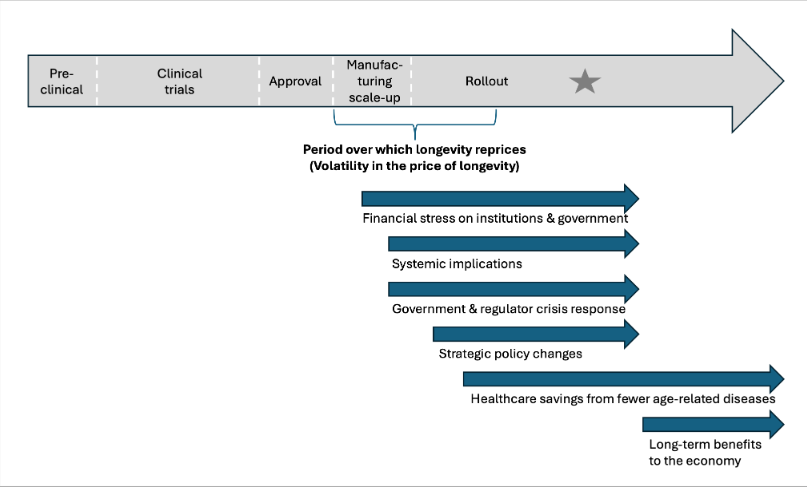
Their scenario draws attention to a systemic risk: pension and annuity liabilities are expected to increase once it becomes obvious that people will live longer, perhaps just shortly after the clinical trial results come in. In short, when it’s obvious that people will live longer, but years and in some cases decades before people outside the trial actually live longer. The paper estimates the increase in defined benefit pension liabilities at 30-45%, and in annuity liabilities at 30–35%. It also points out that the usual methods of mitigating risk might not help: most UK longevity risk is held by a small number of reinsurers, who would be hit by the same shock at the same time.
One important consideration is that these scenarios only play out if the hypothetical longevity improvements reach almost everyone. If they are only luxuries for the ultra-rich, it wouldn’t affect the wider population, or most pension funds. However, Coughlan and Faragher have a reasonable argument to assume widespread access – that the first effective drugs targeting ageing are likely to be repurposed medicines costing pence or pounds a dose. Similar to statins and antihypertensives, these could be rolled out to large populations within a few years (they hypothesise > 85% of over-60s in high-income countries in 5 years). We’ve written before about why longevity treatments are unlikely to be just for billionaires, and this report is a good illustration of the point: the scenario that should worry actuaries – but be good news for us all! – is the one where everybody gets the drug.
The good news
The macro, long-run picture is much more positive: longer, healthier lives could fuel substantial economic growth through a larger and more productive workforce, lower healthcare and long-term-care costs, and higher levels of saving and investment. But those benefits arrive over the longer term. Like many other systemic risks (climate change, AI) there is an important question around how to manage the transition, how do we do it fairly, and how to make sure pensions keep being paid during it.
One way the hedge against longevity risk could be to invest in pharma or biotech companies whose market value would be increased if they developed a longevity drug: if they succeed, pension liabilities and their value would increase together. However, this scenario explores what would happen if the breakthrough drug were a cheap generic—and that wouldn’t result in immediate changes to biotech valuations, though it would probably increase the value of the sector in the medium term by providing a proof-of-principle that longevity medicines can work.
It’s good to see finance engaging seriously with the biology of ageing. At The Longevity Initiative, we think this is a genuine risk with significant fiscal and policy implications. It is also, importantly, a scenario rather than a forecast: the authors are explicit that they are not putting a probability on it, but arguing that the asymmetry between the cost of preparing and the cost of being caught out is large enough to justify taking it seriously.
We work on the science and policy side of longevity, and the inputs to any scenario like this – what longevity medicines do, for whom, and how quickly – are where much of the uncertainty lies. We’re also interested in the policy responses and portfolio allocations that could soften the financial disruption from what would, from a human perspective, be an extraordinary medical breakthrough.
If you or your organisation is thinking about these questions, we’d be very interested in collaborating with you or hearing feedback on what you want to see us work on – you can get in touch here.
You can read Coughlan and Faragher’s full report here.