Can longevity save us from a population crisis?
Our World in Data just released a tool which lets people investigate how populations will change between now and 2100, under both the UN’s population projections, and with changes in birth rates, migration and longevity.
OWID researcher Hannah Ritchie released an accompanying article showing the demographic handbrake turns that would be required to reverse South Korea’s famously cratering population. To counter the fertility rate of just 0.7 children per woman would require either a massive, sustained increase in migration, or a life expectancy rise from 82 today to 130 by 2050—which would certainly be a bold projection for the future of human longevity.
A lot of recent reporting focusses on collapsing birth rates. A major data-driven investigation from the Financial Times explores some of the reasons for the collapse. It also points out that UN projections on birth rates may be too optimistic: their forecast for South Korean births in 2023 was 50% too high. However, playing around with the OWID tool reveals the other side of the ledger: UN life expectancy projections could be too pessimistic, and improving our longevity could play a critical role in our demographic future.
1. The global picture
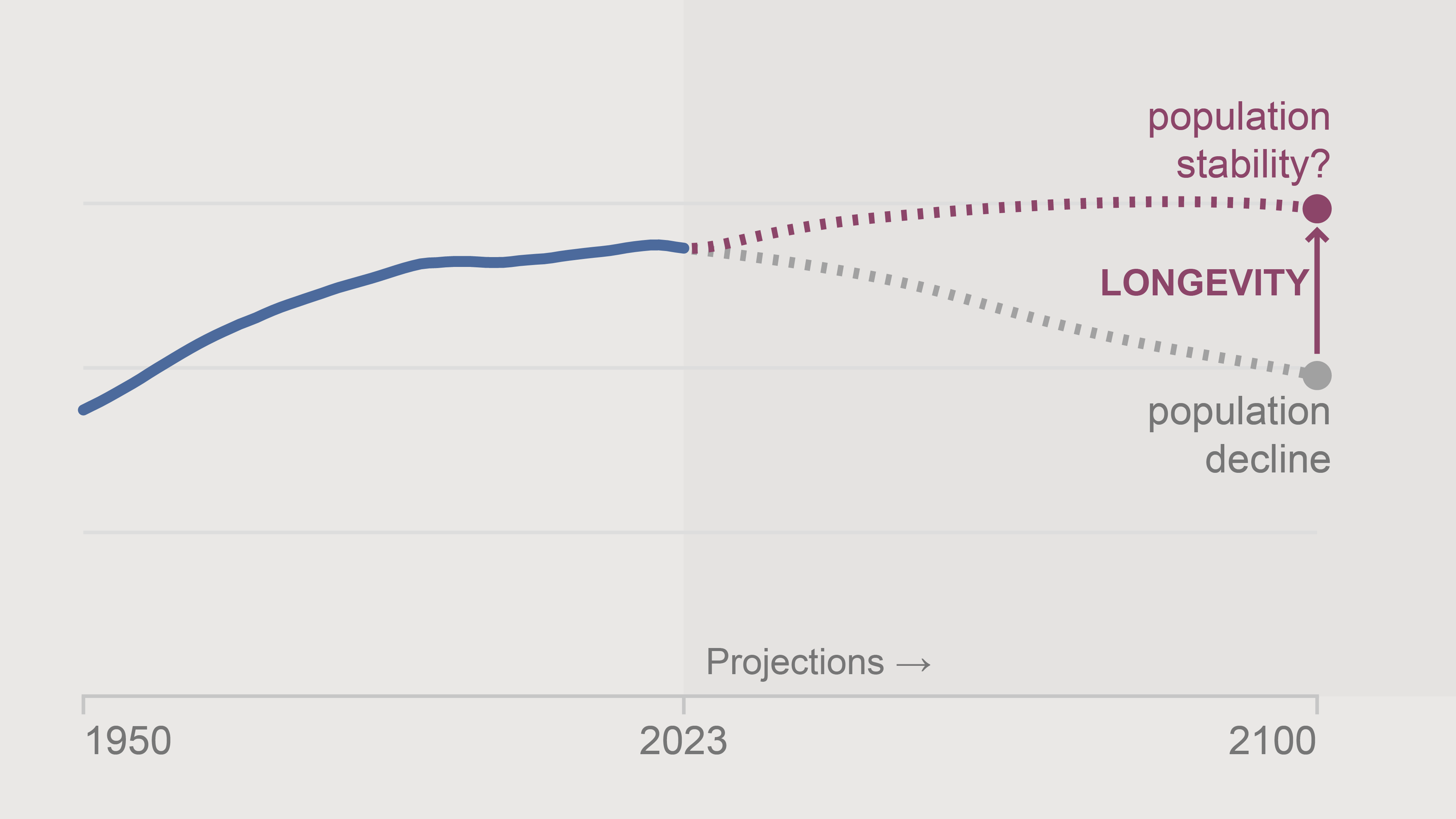
The United Nations provides the world’s most widely cited demographic projections. Their ‘best guess’ medium variant shows the world population continuing to grow from around 8 billion today to 10 billion by 2060, and plateauing just above that level until 2100. This isn’t the demographic decline we’re so often warned about, but decades of population stability on the global scale.
If we set the simulator’s life expectancy slider to a linear rise from 74 in 2030 to 95 by 2100, holding fertility at the UN’s defaults, population in 2100 increases to roughly 11.7 billion—1.6 billion more people, or roughly 16% above the UN’s central case.
How many people will live in the world by 2100?

Is 95 by 2100 a reasonable target? Global life expectancy today is 73 years, meaning we’d need life expectancy to rise by around 3.5 months per year to achieve it. Historically, ‘best practice’ life expectancy in the leading country globally has risen by about 3 months per year since the 19th century, but some demographers argue that this progress could be slowing down. So 3.5 months per year is optimistic, but not inconceivable based on historical trends—especially if we can make some longevity science breakthroughs in the next few decades.
However, the UN’s baseline sides with the pessimistic demographers, assuming a global life expectancy of around 81 by 2100—a gain of more like 1 month per year between now and then. Even excluding the possibility of longevity breakthroughs, the leading countries today have life expectancies around 85. Should we base our demographic future on the expectation that the average country won’t have caught up with what’s already demonstrably possible today, over the next 75 years?
2. Europe
While the global picture is demographic stability, it’s not just South Korea where population decline is a live possibility. The UN’s medium projection for Europe has the population falling from 750 million today to around 590 million by 2100—a loss of about 160 million people, driven by fertility rates that have been well below replacement for decades and that the UN expects to remain that way.
If we set a linear rise to a life expectancy of 100 by 2100 (the OWID calculator allows a slightly higher maximum for Europe than globally), with fertility and migration projections unchanged, the projection for 2100 lifts to 650 million.
How many people will live in Europe by 2100?
Improving life expectancy doesn’t reverse population decline in Europe, but it does slow it by roughly 40%. However, in spite of its potential to be a large part of the solution, improving longevity almost never gets an airing in the increasingly common debates on global fertility and population.
3. The UK
The UK’s population trend is closer to the global one than Europe’s, thanks to slightly higher fertility and substantially higher net migration. As a result, the UN’s baseline has the UK growing modestly from 69 million today to about 75 million by 2100, with a gentle decline late in the century.
Set OWID’s longevity slider to 100 by 2100 and the projection rises to 82 million, and the plateau occurs later than the UN’s medium variant projects.
How many people will live in the United Kingdom by 2100?
However, the UK also shows us that this kind of progress is not automatic. Life expectancy in the UK has been flat since around 2011. And, when it comes not just to how long we live but how well, the UK has actually gone backwards: of 21 high-income countries compared a report from the Health Foundation, it is one of only five to see healthy life expectancy fall between 2011 and 2021. A return to historical gains would require a significant improvement on the current trend—and the UK should implement policies to make sure that population health and life expectancy do not get stuck at this level for even longer.
4. The US
The US story is structurally similar to the UK’s, but with more population growth: the UN’s baseline already has the country growing from 340 million today to 420 million by 2100, fuelled by higher fertility and more sustained migration than most rich countries. Our optimistic longevity scenario would add another 30 million on top.
How many people will live in the United States by 2100?
But population growth and population health are pulling in opposite directions in the US. The Health Foundation put the United States at the bottom of all 21 high-income countries—worse even than the UK. Policies to improve this—from addressing midlife mortality to investing in longevity science—are even more urgent here.
What about ageing populations?
It’s easy to focus on the headline population numbers, but a critical second variable is the population ‘age structure’—the number of older versus younger people. Longevity gains can help slow demographic declines in certain countries, but the same gains mean more people in their 80s, 90s and even 100s under optimistic scenarios. Would this take us out of the frying pan and into the fire, avoiding demographic collapse only to create crisis of dependency, in which a shrinking working-age population supports a swelling cohort of pensioners?
This concern is partly justified when looking at the longevity gains of recent decades, where lifespan has probably increased a little faster than healthspan—people are living longer, but some of those extra years are spent in poor health.
However, it’s biologically unlikely that this trend would hold with more extreme life expectancy changes. If South Korea did manage to raise its life expectancy to 130, it would need to reduce the number of deaths at 80, 90, 100 and beyond by enormous factors. The diseases that kill us at those ages—cancer, heart disease, dementia, and so on—are driven by the same biology that causes the disability used to justify retiring at 65. The only way to increase life expectancy that dramatically would require us to reduce both the diseases and the general frailty, which means it’s very unlikely that everyone over 65 would be a ‘dependent’, unable to work.
Headlines like ‘two pensioners per worker’ don’t make sense under these circumstances. And, while raising pension ages will likely continue to be politically fraught, it would be much easier in a world where people were living healthily into our 90s, or even beyond.
It’s definitely worth going and playing around with the OWID simulator if you haven’t already, and seeing how your country or continent might shrink or grow in future. And we at The Longevity Initiative think it would be worth demographers taking more substantial increases in life expectancy seriously—with seven and a half decades until the end of the century, there’s plenty of time for breakthroughs in longevity science to change our demographic destiny.